
Generic sustainability language is losing its audience. Four years of Google search data from the UK and US show what consumers are searching for instead, and what that means for your brand.
There’s a particular kind of erosion that happens to words when they become too useful. They get borrowed from one context, then another, then a hundred more, until the meaning stretches so thin it tears. “Eco-friendly” has been through this process. So has “green.” So, increasingly, has “sustainable.”
Four years of Google Keyword Planner data, covering July 2022 to June 2026, show this shift playing out across both markets and in a specific product category that makes it particularly legible: deodorant. The lessons it reveals apply to any sustainable brand, in any category.
What the broad picture tells us
In the UK, the broad search terms associated with sustainability are in decline across the board. Searches for “eco friendly” have fallen 38% since 2022, from a monthly average of 5,817 to 3,592. Searches for “sustainable” as a standalone term have dropped 39%, from 52,342 to 31,817 monthly searches.
UK consumers aren’t disengaging from sustainability as a topic; they’re becoming more precise about it. The language of vague commitment is giving way to the language of specific claims, and the deodorant category shows exactly how.
Case study: The deodorant industry
In the deodorant category, “sustainable deodorant” has fallen 47% over the four-year period, from a monthly average of 232 searches to 122. “Eco friendly deodorant” has fallen 43%, from 502 to 286. “Zero waste deodorant” has fallen 68%. These terms were declining even before greenwashing scepticism became mainstream. They never captured the language consumers actually reach for when they want a product with genuine credentials.
What consumers are searching for instead is more specific. “Aluminum free deodorant” has grown 61% in the UK. “Best natural deodorant” has grown 48%. “Natural deodorant” peaked at 11,000 monthly searches in Year 3 of the data and remains at 9,333. These terms tell the searcher something concrete. They describe a benefit, an ingredient difference, or a reason to switch. That specificity is doing work that “sustainable deodorant” never could.
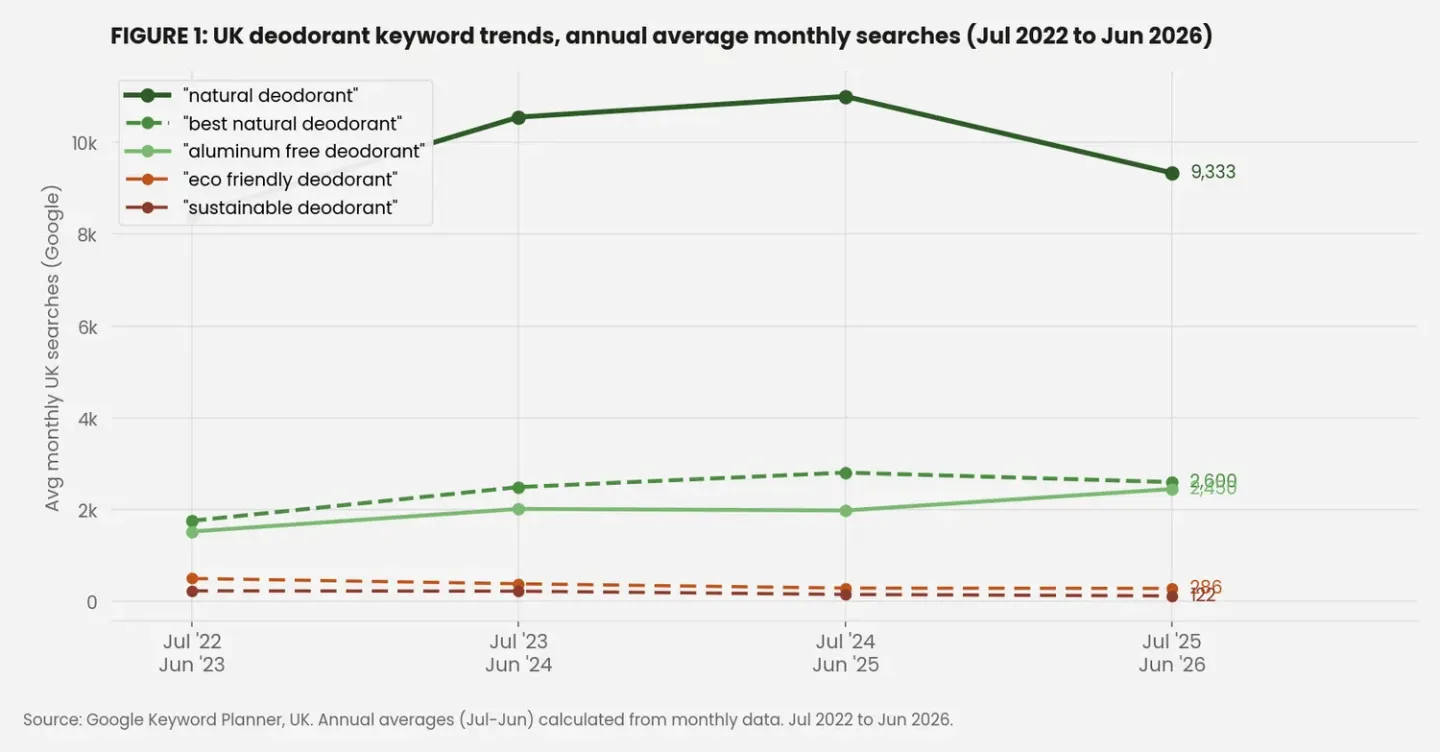
UK & US Natural Deodorant Search Trends
Annual average monthly searches, Y1 (Jul 22–Jun 23) to Y4 (Jul 25–Jun 26). Source: Google Keyword Planner.
| Keyword | Monthly searches (UK) | Monthly searches (US) | UK trend (Y1 to Y4) | US trend (Y1 to Y4) |
| VAGUE SUSTAINABILITY LABELS | ||||
| sustainable deodorant | 170 | 480 | 232 → 122/mo (-47%) | 262 → 933/mo (+256%) |
| eco friendly deodorant | 390 | 480 | 502 → 286/mo (-43%) | 425 → 631/mo (+49%) |
| zero waste deodorant | 70 | 480 | 115 → 37/mo (-68%) | 502 → 252/mo (-50%) |
| TRANSPARENT / SPECIFIC TERMS | ||||
| natural deodorant | 9,900 | 49,500 | 8,425 → 9,333/mo (+11%) | 28,692 → 105,583/mo (+268%) |
| best natural deodorant | 2,400 | 14,800 | 1,758 → 2,600/mo (+48%) | 14,950 → 8,358/mo (-44%) |
| aluminum free deodorant | 1,900 | 90,500 | 1,525 → 2,450/mo (+61%) | 24,058 → 234,250/mo (+874%) |
| best aluminum free deodorant | 390 | 8,100 | 321 → 478/mo (+49%) | 6,925 → 6,342/mo (-8%) |
| natural deodorant for women | 1,000 | 5,400 | 907 → 1,241/mo (+37%) | 6,200 → 5,092/mo (-18%) |
Although the US data shows slight variation by keyword, it has seen the same direction at a considerably larger scale, and with a more dramatic recent shift. “Sustainable deodorant” and “eco-friendly deodorant” have grown 256% and 49%, whereas “aluminum free deodorant” has grown 874%, with volumes of the latter (234,250 searches per month) dwarfing the former, making it one of the fastest-growing health and wellness search terms in the US market.
The chart below shows relative growth on an indexed basis, with actual Y4 volumes annotated.
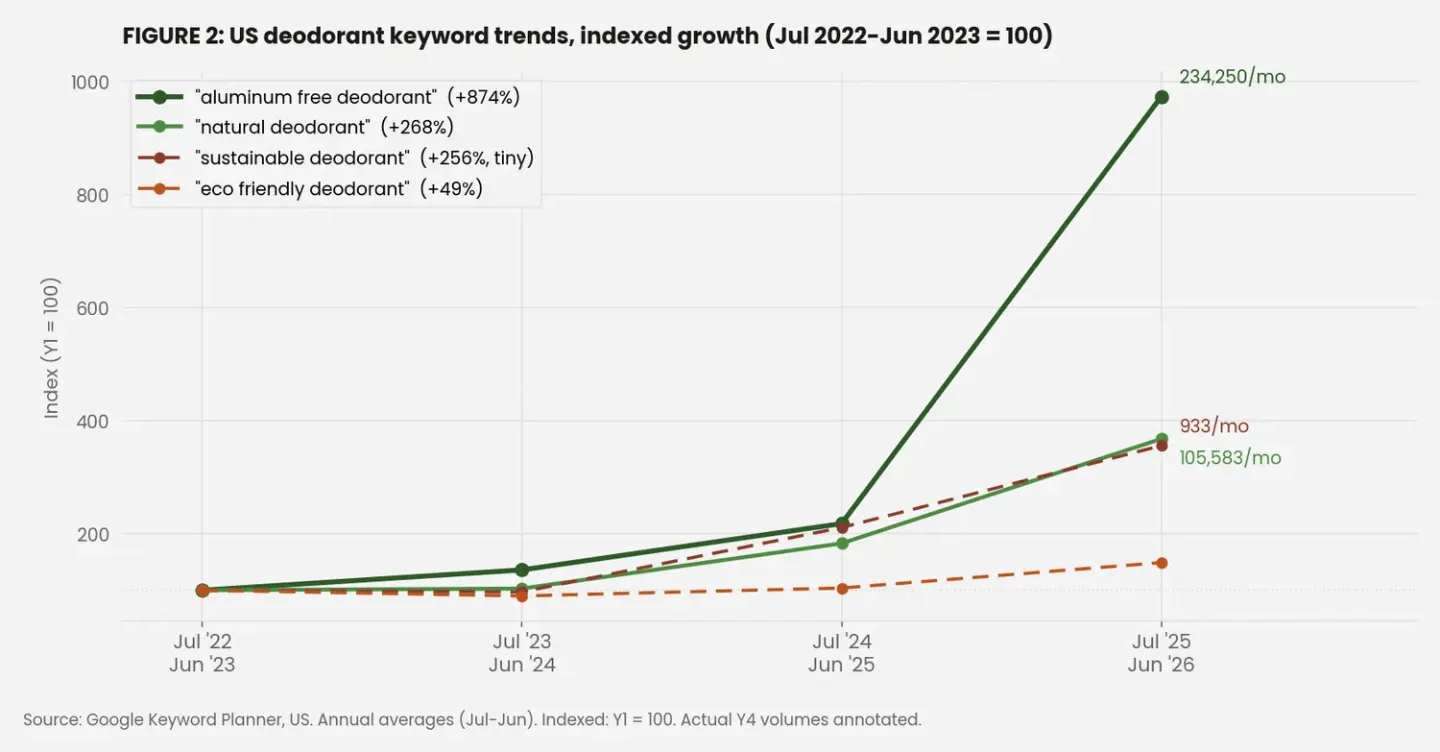
The US Y4 surge in both “natural deodorant” (+268%) and “aluminum free deodorant” (+874%) reflects a significant health and wellness moment in the US market from 2025 onward. The directional lesson is the same: searches that name a specific ingredient, benefit, or product feature are growing; searches that use vague sustainability labels are negligible or declining.
A brand spending its search budget on “sustainable deodorant” (933 monthly US searches) while ignoring “aluminum free deodorant” (234,250) is targeting the smallest possible audience in its market.
-47%

“sustainable deodorant” UK search demand
(Y1 to Y4)
+61%

“aluminium free deodorant” UK growth over the same period
+874%
“aluminum free deodorant” US demand growth
How this should influence your Search strategy
Takeaway #1: Know your audience before you act
These trends describe markets, not individual audiences. A mass-market sustainable deodorant brand and a small-batch artisan product sit in the same category but their customers may use entirely different language to find them. The data above shows the direction of the market overall. It does not tell you what language your specific customers are using, or whether your brand is well-positioned against those terms already.
Acting on market-level data without understanding your own customers’ search behaviour is how brands end up optimising for vocabulary their customers never actually use.
The starting point has to be research: actual evidence of the words your audience reaches for, from search data, on-site behaviour, and customer feedback. Building that picture accurately, for your specific audience, is how you turn market insight into strategy.
GrowRoom’s data services can help you understand exactly how your audience searches, so your content and paid strategy are built on evidence rather than assumptions.
Takeaway #2: Transparency doesn’t just build trust, it builds demand
“Natural deodorant” and “aluminium free deodorant” have seen growth because both describe a product with environmental and health credentials. “Natural deodorant” answers: what is in it? “Aluminium free deodorant” answers: what does it not contain? Each of these terms represents an industry that has educated its audience about a specific benefit rather than making a general claim.
That education creates compounding demand. As consumers understand more about what makes a product different, they search for it more specifically, and that specificity increases over time. The US aluminum-free story, growing nearly tenfold in four years, is one of the most dramatic example of this in consumer goods search right now.
“Sustainable deodorant” answers none of those questions. It asks the consumer to take a claim on trust without the information to evaluate it. In a market where consumers are actively declining to do that, as the declining search volumes show, the brands that educate rather than simply assert are the ones capturing the demand.
Takeaway #3: Don’t abandon high-demand terms – target them differently
The risk of reading this data too simply is overcorrection – there is still relevant demand to target with generic “sustainable” keywords.
If we take housing as another example, “passivhaus” is a specific, industry-known term that describes a building that requires very little energy for heating and cooling. But we can see that a construction company would miss 63% of relevant search demand if they abandoned targeting of generic “sustainable” and “eco” keywords.
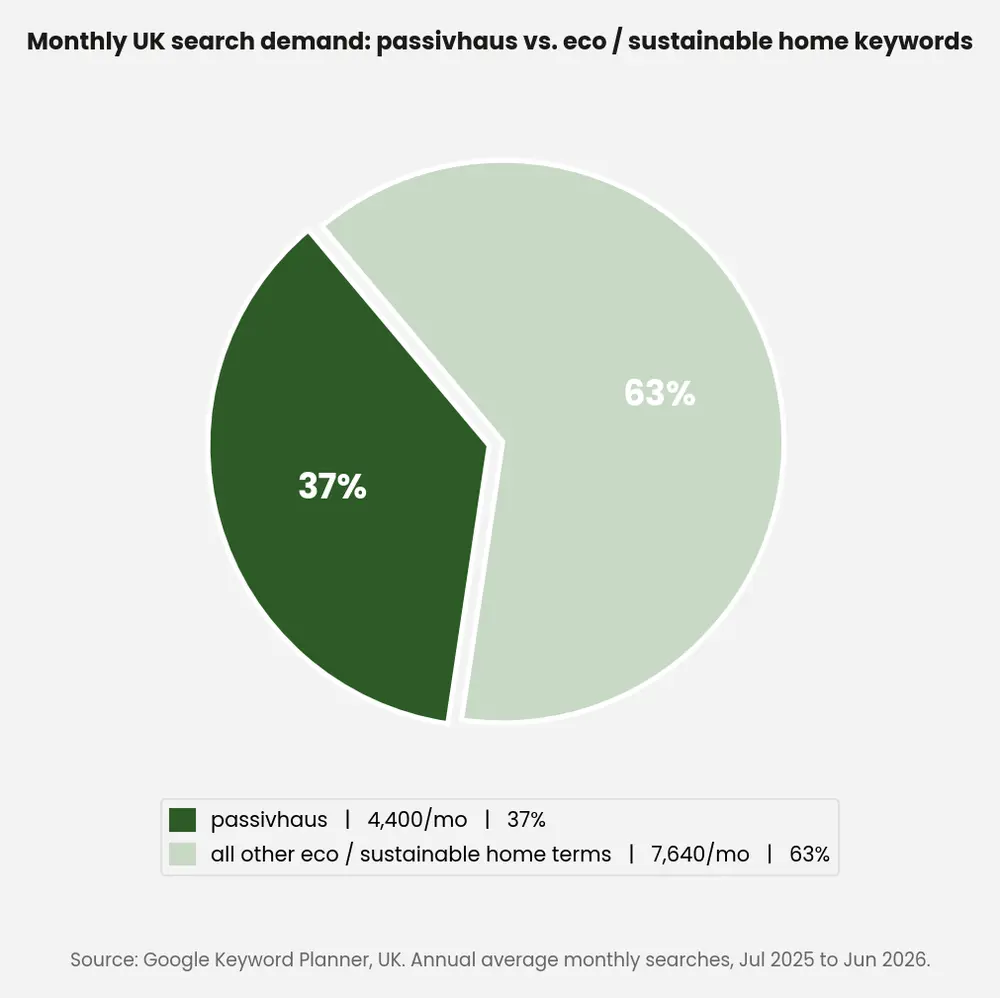
Paid search is well suited to capturing broad, high-volume queries like this because it gives you full control over the landing experience. An ad targeting “sustainable house design” can take searchers to a page that immediately demonstrates what Passivhaus means: the process, specific materials, the certifications, and the scale of energy savings.
Organic content strategy is also a great way to target these generic queries and educate an audience that isn’t yet familiar with specific terms, such as “Passivhaus”. Building authoritative content around “sustainable house design” or “sustainable house materials” creates a durable search presence that can build brand awareness, encourage your audience to learn more about your product or service, and eventually make a purchase or enquiry.
The goal is a search strategy that covers the whole journey: paid search capturing the broad demand, and organic content to educate and build authority around the relevant topics that matter to your audience.
The bottom line
“Eco-friendly” worked as a signal when the baseline was nothing. It told consumers that a brand was at least attempting to engage with environmental impact, but that baseline has moved. Search behaviour is changing because the expectations are changing, and your audience is increasingly asking whether the effort is real, specific, and verifiable.
There has been a language shift in sustainability, and brands that respond with genuine transparency, target broad terms intelligently through paid search and well-crafted landing pages, and take the time to understand how their own audience actually searches will find the new vocabulary is also a better strategy: more credible, more targeted, more durable.
Ready to build a search strategy around language your audience is actually using?